• About
    LeConte-Menu-sm-300.jpg

    In 2009, Zaytuna College was founded in Berkeley, California, with a mission that called for grounding students in the Islamic scholarly tradition as well as in the cultural currents and critical ideas shaping modern society.

  • Academics
    student-book-writing-small.jpg

    Zaytuna College aims to educate and prepare morally committed professional, intellectual, and spiritual leaders who are grounded in the Islamic scholarly tradition and conversant with the cultural currents and critical ideas shaping modern society.

  • Admissions & Aid
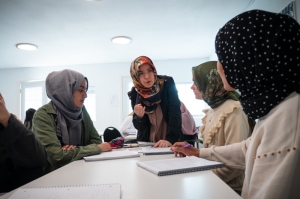
    teacher-students-sisters-small.jpg

    Our mission is to educate students to become morally, intellectually, and spiritually accomplished individuals ready to contribute to our contemporary world in ways that are proportionate to their gifts and to the needs of human society.

  • Campus Life
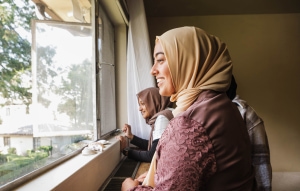
    sisters-looking-out-window-small.jpg

    Zaytuna’s campus is on Holy Hill and students enter the College as part of a cohort, a community of learners that travel together through the curriculum.

Mohamed Lamallam

Assistant Professor

Mohamed Lamallam

Dr. Mohamed Lamallam

Assistant Professor

Biography

Email: mlamallam@zaytuna.edu

Office Hours: By appointment

Dr. Mohamed Lamallam is a scholar of Arabic and Islamic studies whose work bridges classical Islamic learning with contemporary academic scholarship. His field specialties and research include Islamic Ethics, Arabic Literature and Linguistics, Methods and Theories in the Study of Religion, the categories of religion and secularity in Islamic thought, the semantics of the Qur’an and Islamic philosophical theology (kalām), and the intellectual world and writings of al-Māwardī.

At Zaytuna College, Dr. Lamallam teaches Introduction to Hadith, Arabic Grammar and Texts I & II, and Advanced Arabic Studies I & II (al-Raghib’s Muḥādarāt and classical adab anthologies). He is also developing preceptorials on Islamic ethics and topics within the Islamic liberal arts.

Dr. Lamallam received his M.A. and Ph.D. (2024) in Theology and Religious Studies from Georgetown University. Prior to that, he obtained an Ijazah (B.A.) and Taʾhil (Master’s-level qualification) in the Islamic sciences from the University of al-Qarawiyyin, Dar al-Hadith al-Hassania for Higher Islamic Studies in Rabat, Morocco, as well as a B.A. and M.A. in Applied Linguistics from Mohammed V University.

Dr. Lamallam’s doctoral dissertation, titled “Religion and Secularity in Classical Islam: The Dīn/Dunyā Differentiation in the Practical Philosophy and Cultural Context of Abū al-Ḥasan al-Māwardī (d. 450 AH/1058 CE),” investigates how classical Muslim scholars conceptualized the domains of religion (dīn) and worldly life (dunyā) in dialogue with prevailing academic narratives about the nature of Islam and its place in the modern world. By tracing the gradual emergence of conceptual demarcation of domains of knowledge and human activity in the formative centuries of Islam, the thesis examines the functions of religious/worldly differentiation in the classifications of the sciences, political theory, debates over the scope of revealed law, cultural sensibilities reflected in adab literature, and ethical thought.

Dr. Lamallam is a native speaker of Tamazight (Berber) and Arabic, fluent in French, and has a reading proficiency in additional languages such as Persian and German.

Education 


  • Georgetown University, PhD, Theology and Religious Studies, 2024 


  • Georgetown University, MA, Theology and Religious Studies, 2020 


  • Mohammed V University, MS, Applied Linguistics and Teaching Arabic as a Foreign Language, 2018 


  • The University of al-Qarawiyyin, Dar al-Hadith al-Hassania for Higher Islamic Studies, Taʾhil (Master’s-level qualification), 2017 


  • Mohammed V University, MS, Linguistics, 2016 


  • University of al-Qarawiyyin, Dar al-Hadith al-Hassania for Higher Islamic Studies, Ijazah (BA), 2015 

Publications 


Journal Articles  


  • “Al-Māwardī’s (d. 450/1058) Jurisprudential Thought in Classical Islam: An Integrated and Responsive System of Ijtihād and Taqlīd.” Nama Journal of Islamic Sciences and Humanities 2, special issue, vol. 9 (June 2025): 180–205. 


  • Hassan Belhiah and Mohamed Lamallam. “Mother Tongue Medium of Instruction in Morocco: Students’ and Teachers’ Perceptions.” Journal of Applied Language and Culture Studies 3 (2020): 91–111. 


  • Translated into Arabic: Farrin, Raymond K. “Sūrat al-Baqara: A Structural Analysis.” Majallat al-Ta’wīl, no. 4–6 (Shawwal 1441/June 2020): 285–308. 


Book Chapters 


  • “Aḥmad Raysūnī’s Minimalist Political Theory: Freedom at the Nexus of Human Fiṭra, the Umma, and State Power.” In Contemporary Moroccan Thought: On Theology, Philosophy, Society, and Culture, edited by Mohammed Hashas. Brill Handbook Series, 435–59. Leiden: Brill, 2024. 


  • “Juhūd gharbiyya ḥadītha fī dirāsat al-muṣṭalaḥāt al-qurʾāniyya (Recent Western Approaches to the Study of Qurʾanic Concepts).” In al-Aʿmāl al-kāmila li-l-muʾtamar al-ʿālamī al-rābiʿ li-l-bāḥithīn fī al-Qurʾān al-karīm wa-ʿulūmih: April 13–15, 2017, 1126–1169. Fez: Muʾassasat al-Buḥūth wa-l-Dirāsāt al-ʿIlmiyya (Mobdii), 2017. 


Book Reviews 


  • Review of The Islamic Secular by Sherman Jackson. Oxford: Oxford University Press, 2024. American Journal of Islam and Society 42, no. 3–4 (November 2025): 138–42. 


  • Review of Philosophy and Jurisprudence in the Islamic World, edited by Peter Adamson. Berlin: de Gruyter, 2019. Philosmus 5–6 (2024): 363–78. 


Works Under Review 


  • “The Circle of Harmony: Revealed Law, Virtue, and Social Embeddedness in al-Māwardī’s Moral Philosophy.” Brill. Forthcoming.  


  • Review of Dialogues for the Future, by Ṭāhā ʿAbd al-Raḥmān, trans. Abdellah El Boubekri. Modern Intellectual Trends 1. Leiden: Brill, 2023. Forthcoming in Islamochristiana: The Journal of the Pontifical Institute for Arabic and Islamic Studies. 


  • “Al-Māwardī’s (d. 450/1058) Normative Discourse between Islamic Jurisprudence, Philosophy, and Adab: From a Legalistic to a Systematic and Historical-Contextual Reading.” Forthcoming in Philosmus: Journal of Philosophy and Science in Muslim Contexts (in Arabic). 


Works in Progress 


  • “Semantic Tolerance: Linguistic Difference in Islamic Classical Kalām Theology” 


  • “Ethics between Adab and Ḥadīth: The Systematization of Islamic Ethics in Ibn Ḥibbān’s (d. 354/965) Rawḍat al-ʿUqalāʾ wa-nuzhat al-fuḍalāʾ 


  • “Al-Māwardī’s Exegetical Method and the Place of His Nukat in the Formation of the Sunnī Tafsīr Tradition”