


Starting an Important Conversation
Senior Studies Modern Agriculture and Islam
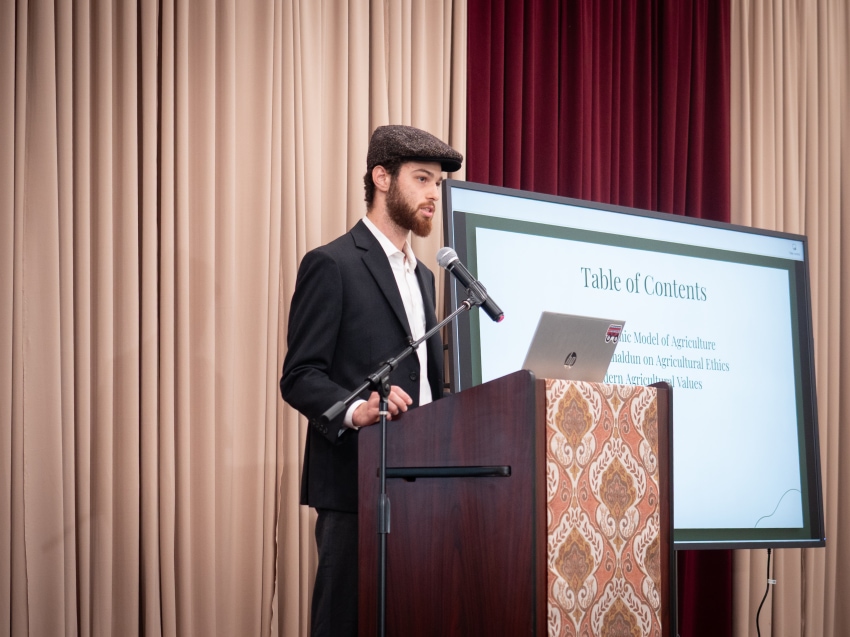
Othman Tomeh wants more Muslims to think seriously about what they eat and where it comes from. “Aligning our food production and consumption with our Islamic values is more than a lifestyle choice; it’s a religious duty. . . If our goal is to create communities of justice, mercy, and health, then our agricultural practices must reflect those same values,” Othman said. He hopes his thesis, Islamic Ethics and Agriculture, invites others to reflect.
His work examines agricultural practices from the perspective of Islamic values and the impact of modern agriculture on mental, physical, and environmental health. At his recent colloquium presentation to faculty and colleagues, he shared his findings: modern agriculture is antithetical to Islamic values. “Stewardship is a core responsibility assigned to humanity in the Qur’an,” he says. “As caretakers of the earth, we are charged with protecting and sustaining its resources for future generations. Furthermore, the preservation of health is one of the five objectives of Islamic law.”
Othman studied the Abbasid agricultural system as a model for farming practices that align with Islamic ethics. Muslim farmers of that era brought ihsan, or excellence, to their work by using sustainable practices. The Arab Agricultural Revolution, which began under the Abbasids, also brought innovations in irrigation and agricultural technologies that reflect Islamic principles. During this era, the Abbasids flourished economically, scientifically, and culturally — even as other cultures with failing systems faced famine.
Othman also studied Ibn Khaldun’s Muqaddimah, which links agricultural practices to the rise and fall of civilizations. Khaldoun contrasts the Bedouins’ simple and nomadic lifestyle, which he argues is closer to our fitra (original true nature), with the sedentary life, which the author argues weakens the body and mind, corrupts the soul, and leads to societal decay and eventually collapse. Again and again, history has confirmed Ibn Khaldun’s insights.
During the lively discussion that followed his presentation, faculty commented on the relationship between modern agriculture and capitalism; world hunger as a distribution vs. production problem; and defining “Islamic agriculture” in light of the absence of explicit guidance about food cultivation in our tradition. Citing a dated UN report which stated that the United States could wipe out world famine by donating just 2 percent of the excess wheat destroyed to maintain market price, one faculty member suggested incorporating zakat obligations into the argument that modern agricultural practices are antithetical to Islamic values.
“My hope is that this work starts an important conversation among Muslims about food consumption and cultivation practices that align with our tradition,” Othman, who hopes one day to work in agriculture.