


Differences Are Our Strength
Senior Studies Diverse Manifestations of Islamic Practice
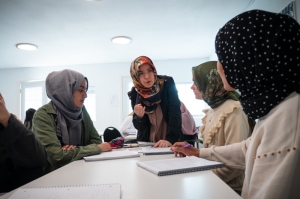
Inaya Robinson (BA Class of 2026) aspires to change perceptions of diverse manifestations of Islamic practice. She believes such differences, often misinterpreted as signs of division and decline, are actually a strength as well as a source of vitality and continuity.
“I want to understand why differences exist and what they reveal about the mercy and flexibility built into our tradition. The more I explore, the more I recognize that diversity is not a weakness; it is one of the greatest strengths of our legal and spiritual heritage,” she said.
Her thesis, Echoes of Revelation: How Hermeneutical Diversity Sustains the Applicability of Islam, analyzes the distinct interpretive frameworks of the four imams in light of linguistic nuance, cultural context, and evaluative criteria. Her work demonstrates the equal validity of these diverse rulings and how the principled diversity within jurisprudence preserves the timeless applicability of Islam.
In her recent colloquium presentation, she shared work she says is intended for lay Muslims who may share her past experiences of confusion related to differences in practice. Citing the “moon wars” as an example, she pointed out that for some students, Zaytuna College celebrates Eid on a different day than their families do. In pre-modern times, Muslims had access to a local imam for religious guidance. Many modern Muslims lack such access, so they consult “Shaykh Google,” finding different opinions online that lack context. What does taqlid, or choosing which guidance to follow, look like in the age of the internet, when the imam is replaced by online platforms? How can lay Muslims develop criteria to distinguish credible scholarly guidance from popular but unqualified voices online? These are some of the questions that will guide her future research.
She is also interested to explore what psychological and social factors make differences seem divisive to Muslims — and how these perceptions might be challenged. “While revelation itself never changes, its application in the world does, because circumstances, language, and societies evolve,” she said. She aspires to produce work that helps Muslims understand such differences not as discordant, but as “hermeneutical harmony,” or multiple echoes of the same revelation.
In the discussion that followed her presentation, faculty and colleagues discussed the parameters of principled interpretation as they relate to the core tenets of Islam; criteria lay Muslims might use to distinguish between different online opinions; evidence that interpretive differences are not only excusable but also beneficial; interpretations of zakat in a modern economy; ideological intolerance; and whether thinking outside the four imams takes someone outside the fold of Islam. Books cited include The Four Imams, The Distinguished Jurist’s Primer, and The Ethics of Disagreement in Islam.
In closing, Inaya thanked faculty and colleagues for their input. “I want my thesis to be practical and help people remain on the straight path in whatever form that path takes, without feeling alienated or inferior because their practice looks different from someone else’s,” Inaya said.