

Path to a More Peaceful Future
Studying Shaykh bin Bayyah’s Fiqh of Citizenship

Is the modern nation-state compatible with Islam? Are contemporary concepts of citizenship, pluralism, and governance aligned with Islamic principles? These questions were common in Jaohara Mahamood’s community in Kerala, India, where some Muslims called Shaykh bin Bayyah a modernist, or a neo-traditionalist, and accused him of trying to secularize Islam.
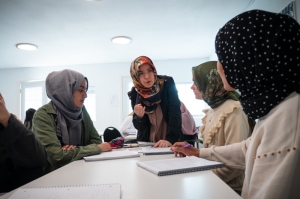
Ms. Mahamood is now a Master’s student at Zaytuna, and her thesis seeks to answer these questions by studying Shaykh bin Bayyah’s legal methodology, which harmonizes Islamic jurisprudence with contemporary realities. As she shared in her recent presentation to professors and peers, she is gaining deeper appreciation for Islamic jurisprudence as a living tradition—and finding his conclusions more optimistic than other scholarship she’s seen on this issue.
Her research focuses on three aspects: his employment of the jurisprudence of reality (fiqh al-wāqiʿ) to integrate modern concepts with Islamic thought; his reinterpretation of the Medina Charter as a model of inclusive citizenship; and his contextual application of Islamic principles to modern governance.
According to Shaykh bin Bayyah, it would be both unrealistic and undesirable to seek to reestablish an Islamic caliphate. The nation-state, he believes, is an inescapable reality of the modern world. As long as its ethical foundation is to promote benefit and avoid harm, it may be considered legitimate. He makes the case that the Charter of Medina, the Prophet’s ﷺ constitutional agreement with Jewish tribes, legitimizes the concept of voluntary citizenship in Islam and provides a framework for building a multi-cultural society that ensures religious freedom and equal opportunity for all. He cites the Qur’an’s multi-dimensional approach to loyalty as the basis for his claim that Muslims can be loyal to both their faith and their community. While he acknowledges the complexity of building a more inclusive interfaith community, he is unequivocal that the alternative of conflict and bloodshed is unacceptable. His work invites Muslims to engage in interfaith dialogue as a path to a more peaceful future.
A rich dialogue followed Ms. Mahamood’s presentation. One professor pointed out that the terms “traditional” and “modern” may impose a secular understanding of contemporary Islam and obscure the reality of Islam as a living tradition. Another pointed out that democratic elections are not necessarily aligned with Islamic principles valuing quality over quantity. A student inquired to what extent Shaykh Bin Bayyah’s core principles come from the work of Aristotle and other western thinkers. Another one asked how one defines an Islamic State — and pointed out that many Muslim societies, including Mauritania, fit that description.
A faculty member suggested that Shaykh bin Bayyah’s unique background is relevant to his work. Born in 1935, in what is now Mauritania, he came from the peacemaking Zawāyah clan. The intention to spread peace is at the heart of his scholarship. He has a PhD in constitutional governments, and as one of Mauritania’s three founders, he wrote that country’s constitution. This additional information inspires Ms. Mahamood to study Shaykh bin Bayyah’s background and include key details in her thesis.
With just a few months remaining in her Master’s program, Ms. Mahamood is looking forward to returning to Kerala, where she intends to continue her studies. Her dream? To start a madrasa for girls. “Where I studied in Kerala, all the teachers were men,” she explained, “So there was a limit to the suhba I could experience with scholars.” She envisions a madrassah where female scholars and their students can benefit fully from the richness of spiritual companionship on the path of seeking knowledge.
Jaohara Mahamood is a MA student in the Islamic Texts program.