


MA Student Applies Islamic Ethics to Persuasive AI
A massive experiment is unfolding all around us, in real time, as the use of AI increases exponentially. It may take years for its impact on individual and collective life to be revealed, but one thing is already clear: safety mechanisms are needed to avoid AI-related catastrophes, and the ethical frameworks that currently govern its use are insufficient. That’s why religious leaders are racing to participate in the creation of a code of ethics for its use and development. How might Islamic ethics inform the development and use of AI for the benefit of humanity?
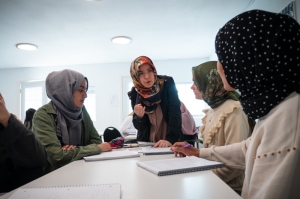
This question led Omar Al-Naggar, a former robotics engineer, to pursue a master’s degree in Islamic Texts with a concentration in Islamic Law at Zaytuna College. Now in his second year, he offered some compelling answers during his recent MA colloquium titled “Decision-making under the influence (DUI) of persuasive artificial intelligence.” These colloquia give students an opportunity to present their thesis research and critically engage with their professors and peers.
His thesis examines persuasive AI’s impact through the lens of maqasid al-shariah, with an emphasis on the higher objective of preservation of the intellect. Omar argues that the higher objective of preserving the intellect goes beyond intoxicants to include manipulative technologies. Of the many kinds of AI, Omar chose to focus his work on the influence of persuasive AI due to its singular manipulation of the human intellect through personalizing persuasion, obscuring reality, and nudging decision-making. In addition to assessing benefit and harm of persuasive AI on intellectual faculties, his thesis offers guidance for establishing ethical policies based on principles of Islamic jurisprudence.
Omar closed his presentation with two provocative questions: Are you sure your decisions have been your own? And how many will remain your own? He then invited feedback and fielded questions. One faculty member praised him for work that embodies Zaytuna’s mission and reveals the importance of its curriculum. Another encouraged Omar to examine user responsibilities in addition to creator responsibilities. A third asked if his research will also include an examination of tech infrastructure, whose benefits and harm are rarely assessed or taken into consideration.
President Hamza Yusuf complimented him on his work, and pointed out that much AI research is being done by the military industrial complex, which was also involved in the development of the internet.
“Muslims have historically been very critical of emergent technologies – not because they were anti-technology, but because they understood the impact of radical disruptions on culture,” President Yusuf said, and encouraged Omar to reflect more on who is behind this manipulative technology.